Tech Ideas That Made the Web Move Quicker: Powerful Innovations That Transformed Speed and Performance

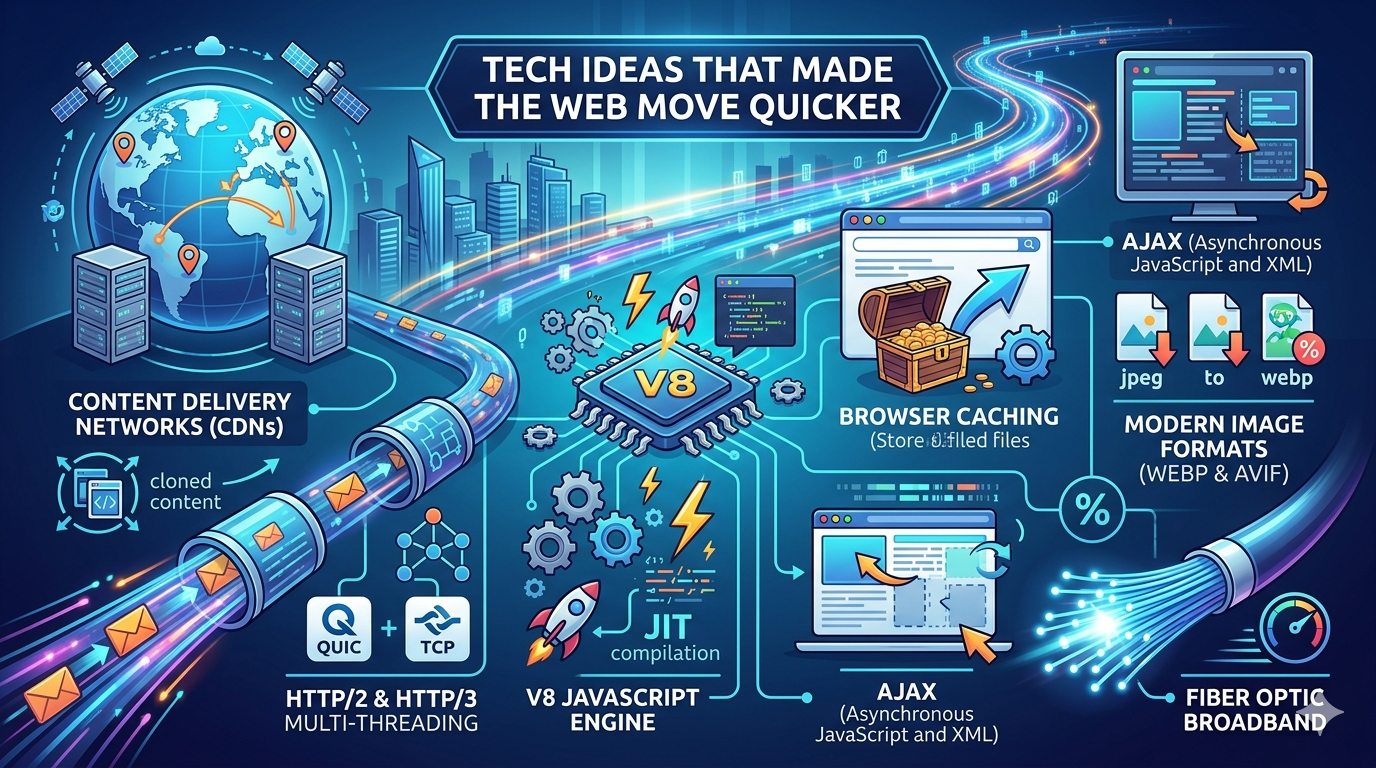
The internet you use today is nothing like it was a decade ago. Tech Ideas That Made the Web Move Quicker Pages load faster, videos stream instantly, and apps feel almost as responsive as native software. But this didn’t happen by accident. Behind the scenes, a series of clever technological ideas and engineering breakthroughs quietly reshaped how the web works.
In this article, we’ll explore the key tech ideas that made the web faster and more efficient. Tech Ideas That Made the Web Move Quicker These innovations didn’t just improve speed—they fundamentally changed how developers build and users experience the internet.
1. Content Delivery Networks (CDNs): Bringing Data Closer to Users
One of the biggest reasons the web feels faster today is the widespread use of Content Delivery Networks, commonly known as CDNs. Tech Ideas That Made the Web Move Quicker The core idea is simple: instead of serving a website from a single server, copies of its content are distributed across multiple servers worldwide.
When a user accesses a website, the CDN delivers content from the server closest to their geographic location. Tech Ideas That Made the Web Move Quicker This reduces latency—the time it takes for data to travel between the server and the user. For example, someone in Pakistan accessing a site hosted in the United States no longer has to wait for data to travel across continents. A nearby CDN node handles the request instead.
CDNs also improve reliability. If one server goes down, another can take over seamlessly. This redundancy ensures minimal downtime and faster recovery. Tech Ideas That Made the Web Move Quicker Companies like Cloudflare and Akamai have built massive infrastructures to support this model, making CDNs a backbone of modern web performance.
2. Browser Caching: Remembering What Matters
Another powerful idea that speeds up the web is browser caching. Tech Ideas That Made the Web Move Quicker Instead of downloading the same files every time you visit a website, your browser stores certain assets—like images, stylesheets, and scripts—locally on your device.
When you revisit the site, the browser loads these cached resources instantly instead of requesting them again from the server. Tech Ideas That Made the Web Move Quicker This drastically reduces loading times and bandwidth usage. It’s especially effective for repeat visits, where most of the content remains unchanged.
Developers can control caching behavior using HTTP headers. Tech Ideas That Made the Web Move Quicker By specifying how long files should be stored and when they should be refreshed, they strike a balance between speed and freshness. This simple concept has had a massive impact on performance, making everyday browsing noticeably quicker.
3. HTTP/2 and HTTP/3: Smarter Communication Protocols
The protocol that governs how data is transferred over the web has evolved significantly. HTTP/1.1, which was widely used for years, had limitations like sequential request handling and inefficient use of connections.
HTTP/2 introduced several improvements, including multiplexing. Tech Ideas That Made the Web Move Quicker This allows multiple requests and responses to be sent simultaneously over a single connection. Instead of waiting for one file to load before requesting another, browsers can fetch many resources at once, reducing delays.
HTTP/3 takes things even further by using a protocol called QUIC, which operates over UDP instead of TCP. This reduces connection setup times and improves performance on unreliable networks. Tech Ideas That Made the Web Move Quicker Together, these advancements have made web communication faster, smoother, and more resilient.
4. Minification and Compression: Sending Less Data
Speed isn’t just about faster connections—it’s also about sending less data. Tech Ideas That Made the Web Move Quicker That’s where minification and compression come into play.
Minification involves removing unnecessary characters from code, such as whitespace, comments, and line breaks. While these elements make code easier to read for humans, they’re not needed for execution. By stripping them away, file sizes become significantly smaller.
Compression techniques like Gzip and Brotli further reduce the size of data transferred over the network. When a browser requests a page, the server sends a compressed version, which the browser then decompresses. Tech Ideas That Made the Web Move Quicker This process happens quickly and results in faster load times.
Together, these techniques ensure that websites deliver only what’s necessary, making the web leaner and more efficient.
5. Lazy Loading: Loading Only What You Need
Lazy loading is a smart strategy that delays the loading of non-essential content until it’s actually needed. For example, images or videos that are not visible on the screen when a page first loads are deferred until the user scrolls down.
This approach reduces the initial load time and improves perceived performance. Tech Ideas That Made the Web Move Quicker Users can start interacting with the page sooner, even if all content hasn’t been fully loaded yet.
Lazy loading is especially useful for content-heavy websites, such as blogs, e-commerce platforms, and social media feeds. By prioritizing visible content, it creates a smoother and faster user experience.
6. JavaScript Optimization: Making Code More Efficient
JavaScript is a powerful tool, but it can also slow down websites if not handled properly. Tech Ideas That Made the Web Move Quicker Over time, developers have adopted various techniques to optimize JavaScript performance.
One such technique is code splitting, where large scripts are broken into smaller chunks. Tech Ideas That Made the Web Move Quicker These chunks are loaded only when needed, reducing the initial load time. Another approach is tree shaking, which removes unused code from libraries and frameworks.
Modern JavaScript engines in browsers have also become incredibly efficient. They can compile and execute code faster than ever before. Combined with best practices in development, these improvements ensure that JavaScript enhances functionality without compromising speed.
7. Asynchronous Loading: Doing More at Once
In the early days of the web, resources were loaded synchronously, meaning one file had to finish loading before the next could begin. This created bottlenecks and slowed down page rendering.
Asynchronous loading changed that. It allows multiple resources to load simultaneously without blocking each other. For instance, scripts can be loaded in the background while the rest of the page continues to render.
This approach improves both actual and perceived performance. Users see content appear more quickly, even if some elements are still loading behind the scenes. It’s a subtle but powerful shift that has made modern web pages feel much faster.
8. Progressive Web Apps (PWAs): Blending Web and Native Speed
Progressive Web Apps (PWAs) represent a major leap in web performance. They combine the best features of web and mobile apps, offering fast load times, offline access, and smooth interactions.
PWAs use service workers—scripts that run in the background—to cache resources and handle network requests intelligently. This means that even with a slow or unstable connection, the app can still function effectively.
By minimizing reliance on constant network access, PWAs deliver a near-instant experience. They’ve become increasingly popular for businesses looking to provide a high-performance user experience without requiring users to download a native app.
9. Edge Computing: Processing Data Closer to the Source
Edge computing takes the CDN concept a step further. Instead of just storing static content closer to users, it allows actual data processing to happen at the edge of the network.
This reduces the need to send data back to a central server for processing. Tasks like authentication, personalization, and data filtering can be handled locally, resulting in faster response times.
As applications become more complex, edge computing plays a crucial role in maintaining speed and scalability. It’s particularly important for real-time applications like gaming, streaming, and IoT systems.
10. Image Optimization: Smarter Media Delivery
Images often make up a large portion of a webpage’s size. Optimizing them has been a key factor in improving web speed.
Modern formats like WebP and AVIF offer better compression without sacrificing quality. Additionally, responsive images ensure that users only download the size appropriate for their device.
Techniques like lazy loading and adaptive delivery further enhance performance. By combining these strategies, developers can significantly reduce load times while maintaining visual quality.
Conclusion: A Faster Web Built on Smart Ideas
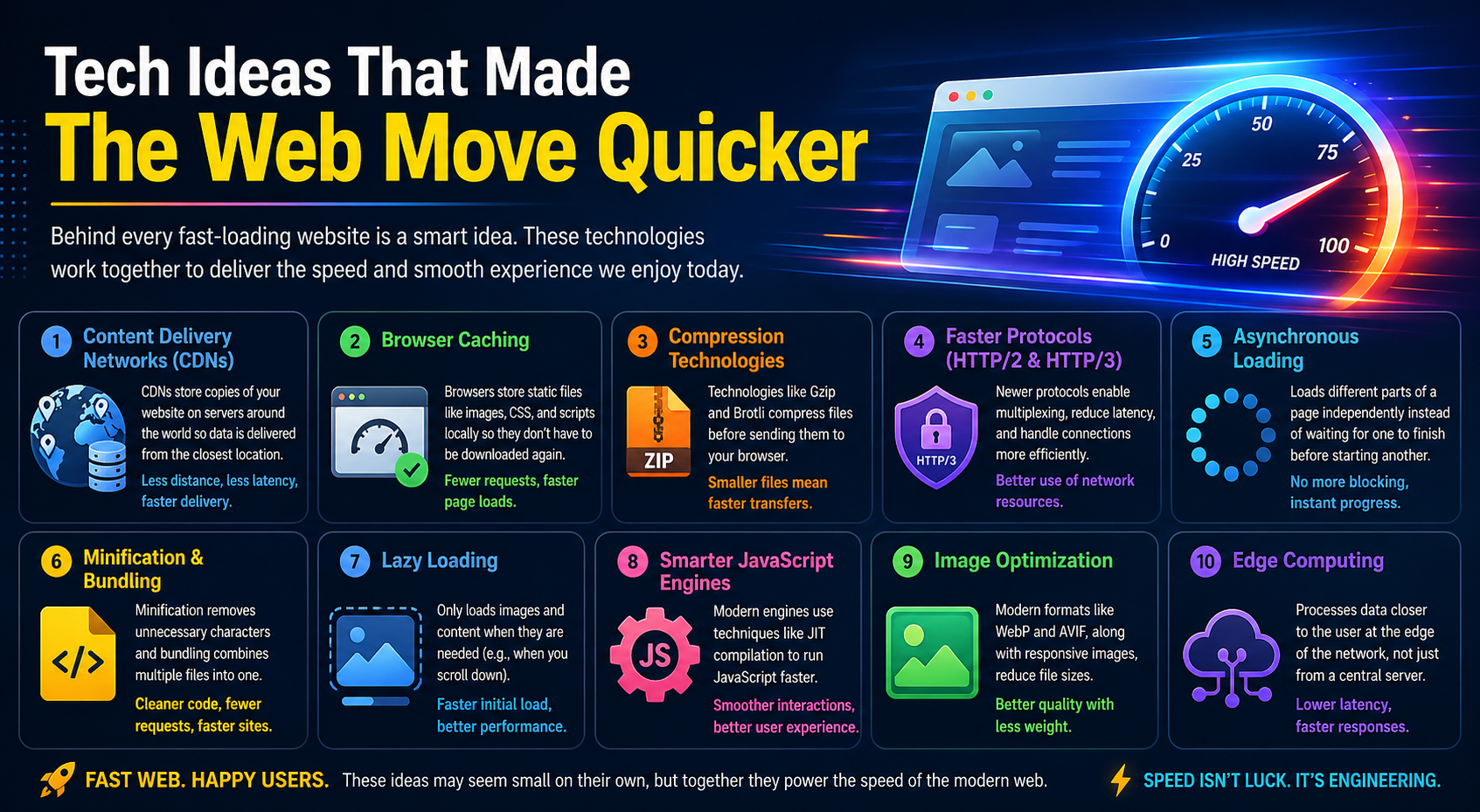
The speed of today’s web is the result of countless innovations working together. From CDNs and caching to modern protocols and edge computing, each idea has played a role in making the internet faster and more reliable.
What’s fascinating is that many of these concepts are not overly complex on their own. The real magic lies in how they are combined and implemented at scale. Developers, engineers, and companies continue to refine these techniques, pushing the boundaries of what’s possible.
As technology evolves, the web will only get faster. But the core principle will remain the same: deliver information as quickly and efficiently as possible. And thanks to these groundbreaking ideas, we’re already experiencing a web that feels almost instantaneous.