SSIS 469: A Practical, Expert Guide to Understanding and Fixing This Common Integration Services Error

SSIS 469 If you’ve worked with SQL Server Integration Services for even a short time, chances are you’ve come across cryptic error codes that seem more confusing than helpful. One of those is SSIS 469—a message that can stop your data flow dead in its tracks if you don’t know what’s behind it.
In this guide, we’ll break down what SSIS 469 actually means, why it happens, and how to fix it efficiently. This isn’t just theory—you’ll get practical insights, real-world scenarios, and actionable steps that can save you hours of frustration.
What Is SSIS 469 and Why Does It Matter?
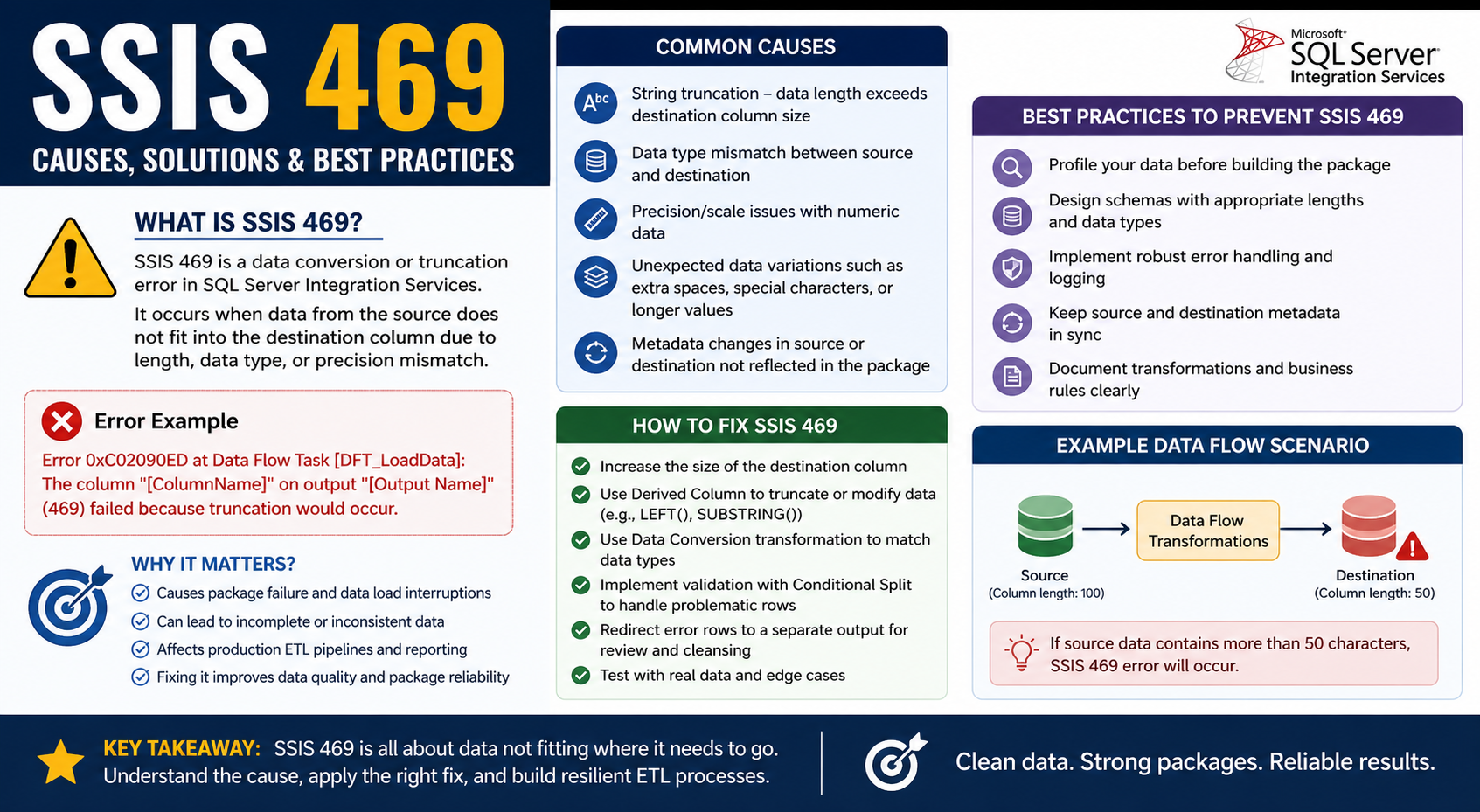
SSIS 469 is typically associated with data conversion and truncation issues within SQL Server Integration Services packages. While the exact wording of the error may vary depending on your setup, it usually signals that data is not fitting into the destination column properly.
At its core, SSIS is extremely strict about data types and sizes. If a source column contains more data than the destination can handle—whether it’s a string length mismatch or incompatible data type—you’ll likely encounter this error. SSIS 469 is essentially the system’s way of saying, “This data doesn’t fit, and I won’t guess how to fix it.”
What makes this error particularly important is its impact. It doesn’t just throw a warning—it often causes package failure, halting your ETL pipeline entirely. In production environments, this can disrupt reporting, analytics, and even downstream business operations.
Understanding SSIS 469 is not just about fixing a single issue. It’s about improving the reliability and resilience of your entire data integration workflow.
Common Causes Behind SSIS 469

To fix SSIS 469 effectively, you need to understand what’s triggering it. While the error might appear generic, the underlying causes usually fall into a few well-defined categories.
One of the most frequent causes is string truncation. For example, if your source column contains 100 characters but your destination column only allows 50, SSIS will not automatically trim the data. Instead, it throws an error. This is by design—SSIS prioritizes data integrity over convenience.
Another common cause is data type mismatch. Imagine trying to insert a Unicode string into a non-Unicode column without proper conversion. Even though the data looks similar, SSIS treats them as different types, leading to conversion errors.
There’s also the issue of unexpected data variations. In real-world datasets, you might encounter anomalies—longer-than-expected strings, null values, or special characters. If your package isn’t designed to handle these cases, SSIS 469 can appear unexpectedly.
Lastly, metadata inconsistencies between source and destination systems can trigger the error. If schemas change but your SSIS package isn’t updated accordingly, mismatches can occur during execution.
How to Identify SSIS 469 in Your Package
When SSIS 469 occurs, it doesn’t always point directly to the exact column causing the issue. That’s where many developers get stuck. However, with a systematic approach, you can pinpoint the problem quickly.
Start by examining the error message details in the SSIS execution logs. These often include clues about the component and column involved. Even if the message is vague, it usually references the failing data flow task.
Next, enable data viewers within your data flow. This allows you to inspect the data as it moves between components. By observing the values just before they reach the destination, you can identify anomalies or oversized data.
Another effective technique is to temporarily redirect error rows. Instead of failing the package, configure the component to send problematic rows to a separate output. This lets you capture and analyze the exact data causing the issue.
Finally, don’t overlook column metadata. Compare the source and destination column definitions carefully—length, data type, precision, and scale. Even a small mismatch can trigger SSIS 469.
Step-by-Step Solutions to Fix SSIS 469
Once you’ve identified the root cause, fixing SSIS 469 becomes much more straightforward. Here are some proven solutions that work in most scenarios.
The first and most obvious fix is to increase the size of the destination column. If truncation is the issue, expanding the column length ensures that all incoming data fits without errors. This is often the cleanest solution when you control the database schema.
If modifying the destination isn’t an option, you can use a Derived Column transformation to truncate or modify the data before it reaches the destination. For example, you can use a substring function to limit the length of incoming strings.
Another approach is to apply explicit data type conversions. Using the Data Conversion transformation, you can align the source data type with the destination requirements. This eliminates compatibility issues that might trigger SSIS 469.
For more complex scenarios, consider implementing data validation logic. You can use Conditional Split transformations to filter out problematic rows or route them to a separate process for cleanup.
Finally, always test your changes with realistic data samples. It’s easy to fix the issue for one dataset but miss edge cases that could cause failures later.
Best Practices to Prevent SSIS 469 in the Future
Fixing SSIS 469 is one thing—preventing it is another. By following a few best practices, you can minimize the chances of encountering this error again.
Start by designing your packages with flexibility in mind. Avoid overly restrictive column sizes unless absolutely necessary. Giving your data some breathing room can prevent many truncation issues.
Next, always perform data profiling before building your ETL process. Understand the range, length, and format of your data. This helps you design schemas and transformations that can handle real-world variations.
It’s also a good idea to implement robust error handling. Instead of letting the entire package fail, configure components to redirect error rows. This keeps your pipeline running while still capturing problematic data for review.
Another important practice is maintaining schema consistency. If your source or destination structures change, update your SSIS package immediately. Keeping everything in sync reduces the risk of unexpected errors.
Lastly, document your transformations and assumptions. When someone else (or even your future self) revisits the package, clear documentation makes troubleshooting much easier.
Real-World Example: Fixing SSIS 469 in a Production Pipeline
Let’s put this into perspective with a real-world scenario. Imagine you’re importing customer data from a CSV file into a database. Everything works fine—until one day, the package fails with SSIS 469.
After investigating, you discover that a customer name exceeds the expected length. The destination column allows 50 characters, but the incoming value is 75 characters long.
At this point, you have a few options. You could increase the column size, truncate the data, or redirect the row for manual review. The right choice depends on your business requirements.
In this case, preserving data integrity is critical. So you decide to expand the column size and add validation logic to flag unusually long entries. The result? The package runs smoothly, and you’ve made it more resilient for future data variations.
This example highlights an important point: SSIS 469 isn’t just an error—it’s an opportunity to improve your data pipeline.
Final Thoughts on SSIS 469
SSIS 469 might seem like a frustrating roadblock at first, but it’s actually a valuable signal. It tells you that your data and schema are out of alignment—and that’s something worth fixing properly.
By understanding the root causes, using the right tools to diagnose the issue, and applying targeted solutions, you can resolve SSIS 469 quickly and effectively. More importantly, you can design your packages in a way that prevents similar issues from happening again.
In the world of data integration, small errors can have big consequences. Taking the time to handle issues like SSIS 469 with care and precision is what separates a basic implementation from a truly robust, production-ready system.